

Sitdown
Well-Known Member
- Joined
- Feb 7, 2020
- Threads
- 12
- Messages
- 156
- Reaction score
- 278
- Location
- Chicago-ish
- Vehicles
- 86 SVO | 65 350R Resto | Raptor R | Holdens

No word back yet... Will update if/when mine progresses
Sponsored

Yeah, I think your car definitely has a problem. But I disagree that the car will maintain the battery when unplugged. I see no evidence that is the case. When I was unplugged, the battery got down to 10% and the only reason it charged back up was because I plugged in the car. This could be the root of the problem for some people, because cold will kill the battery and the MME is not maintaining it when unplugged. The fact that yours dies when plugged in indicates you have a more serious issue.It comes back on and charges it according to your OBD2 readings so no it should not die. Needs to do that every time it drains 10 iphones in 2 hours while not running much.
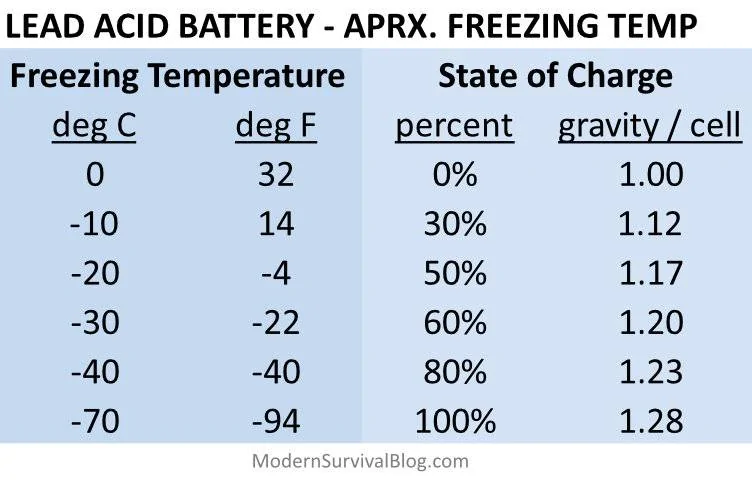
Nothing will happen at 26F I think you should be fine unplugged. It has nothing to do with not being plugged in or not I think. I am plugged in and it happens. It has to do with -15F here. A lead acid 12V at 40% soc should freeze when the temperature goes downs to 5F. If it is -15F and sitting at 40% soc one would think it can not be happy. I would think it sees a soc somewhere in between 40 and 90%. You can not let your 12V go to 40% soc up here in the winter. You also can not have a huge drain on the 12V which makes that condition happen over and over again. The fix will be interesting to see.


This is the best car I've driven yet. I hope they solve the issue otherwise I'll have to trade/sell my MME by next winter. But seeing more people have the same issue gives me some hope that Ford will resolve it asap.No word back yet... Will update if/when mine progresses
Similar testing in upstate, NY at -18c (usually not as tough as northern Canada) shows that MME unplugged maintains does charge the LVB.Yeah, I think your car definitely has a problem. But I disagree that the car will maintain the battery when unplugged. I see no evidence that is the case. When I was unplugged, the battery got down to 10% and the only reason it charged back up was because I plugged in the car. This could be the root of the problem for some people, because cold will kill the battery and the MME is not maintaining it when unplugged. The fact that yours dies when plugged in indicates you have a more serious issue.
If my test tonight is not helpful I won't bother. Just trying to help out.
I had it sitting here for days, over a week, not plugged no problems. As noted the only problem I see here is when it is below 10F. Thinking I can definitely reproduce it at -15F.Yeah, I think your car definitely has a problem. But I disagree that the car will maintain the battery when unplugged. I see no evidence that is the case. When I was unplugged, the battery got down to 10% and the only reason it charged back up was because I plugged in the car. This could be the root of the problem for some people, because cold will kill the battery and the MME is not maintaining it when unplugged. The fact that yours dies when plugged in indicates you have a more serious issue.
If my test tonight is not helpful I won't bother. Just trying to help out.
Do you think if the 12V did get slushy that it could be triggering the car to not close the positive contact? Faulting and the state of 12V triggers it? I think it is recognized science regarding 12V's and you can not keep them at 40% soc in -15F conditions. It has to be SOC(min) = 40 + Fn(T). Wish I could hook the OBD up and watch. Not drawing anything on the 12V here as I have a problem that requires service. Guess I will see here if messing with the HV junction box helps.Similar testing in upstate, NY at -18c (usually not as tough as northern Canada) shows that MME unplugged maintains does charge the LVB.
There are no circumstances where a properly working, software current MME should allow the LVB to go to 10% (but, there are plenty of such reports, you are not alone). I cannot speak to the GT, maybe it has some different issues that have been corrected in the premiums (I have only been testing Louiebluey, a first edition).
It really does sound like the hv junction block with the contactors is the most likely suspect in many or possibly most of these cases now. I wish we had more information about it, but even it we did, with the block inside of the hv battery, it is way beyond a DIY repair for most of us.
The AGM are supposed to be more robust at bitter cold temps, just double check if the cold weather battery references are to lead acid only, or include AGM.I had it sitting here for days, over a week, not plugged no problems. As noted the only problem I see here is when it is below 10F. Thinking I can definitely reproduce it at -15F.
Do you think if the 12V did get slushy that it could be triggering the car to not close the positive contact? Faulting and the state of 12V triggers it? I think it is recognized science regarding 12V's and you can not keep them at 40% soc in -15F conditions. It has to be SOC(min) = 40 + Fn(T). Wish I could hook the OBD up and watch. Not drawing anything on the 12V here as I have a problem that requires service. Guess I will see here if messing with the HV junction box helps.
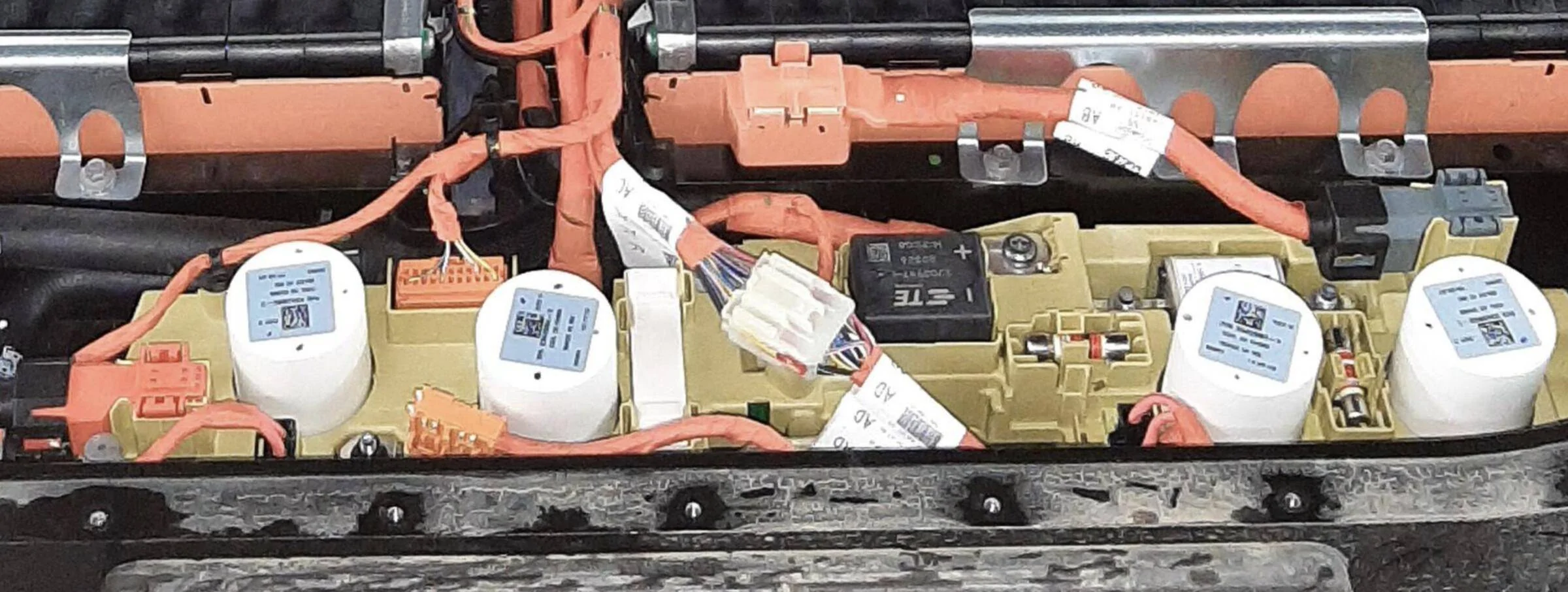
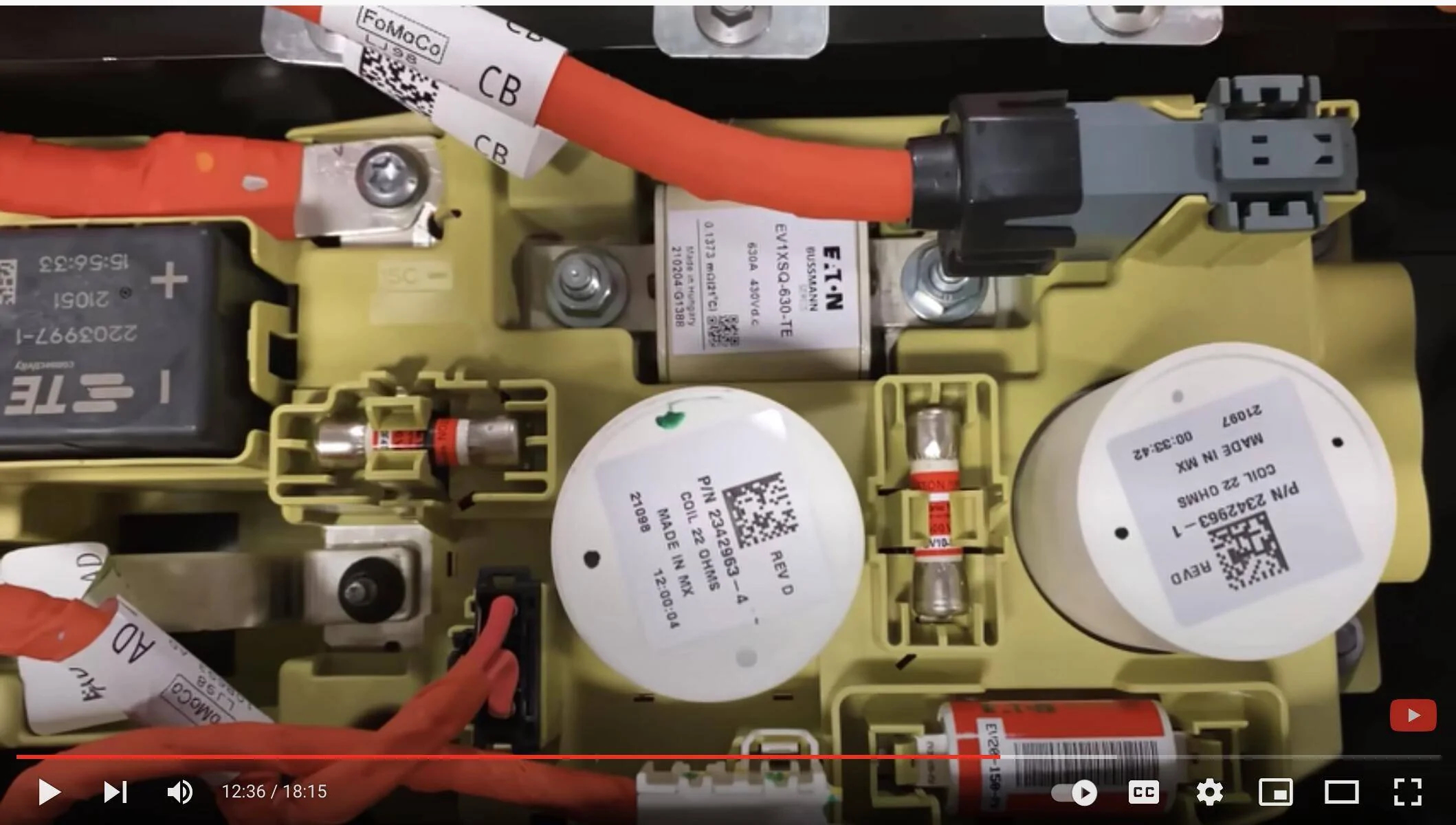
Grey one I see 4 white? Have a high rez of that pic? Couple of substantial old school fuses in there and connectors/junctions. What is the black box (TE) and something to its right behind the 3rd contactor?The AGM are supposed to be more robust at bitter cold temps, just double check if the references are to lead acid only, or include AGM.
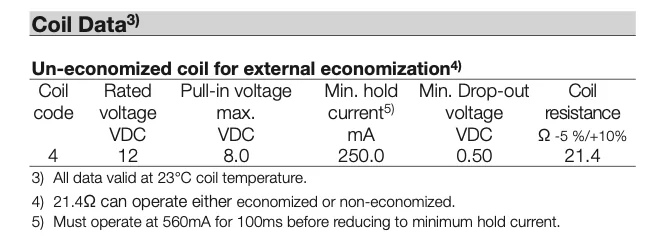
We do not have a lot of information on the hv junction block. There are a number of contactors, and we know that at least four of them (the white cylinders) have a coil resistance of ~22 ohms, and the grey one too.
Not entirely sure how many need to close to charge LVB, MME off, no driving. Possibly (?) precharge, V+, Vneg aux to start DC/DC converter unplugged. So, that is about a 1.6 A for three, or 2A if we need four contactor closures.
It is possible that low LVB cold is the cause of not being able to close contactors. But, some MME seem to be working fine in all conditions. It might be some kind of defect in the hv junction block, one or more bad connections/terminations, defective contactors, some loose 12V ground, almost anywhere inside the HVB enclosure or out that affects the contactor closures?
The smaller rectangular grey contactor is the only one I have a data sheet for:

 .
. 
I doubt they get many test cases at -30c, so yours is definitely working at the edge of the envelope. I doubt in the harshest conditions 50 Ah vs. 35 Ah would fix anything, except the close calls. dead 35 Ah, probably dead 50 Ah too.Grey one I see 4 white? Have a high rez of that pic? Couple of substantial old school fuses in there and connectors/junctions. What is the black box (TE) and something to its right behind the 3rd contactor?
Always rule out the obvious first. Simple is normally the best and most likely fix. Start with the source of the problem and work back. Some get bogged down in the cals (complexity) and miss the big picture. I would assume SOC(min) = 40 + Fn(T) is correct. Just need you to drive your FE up here to the farm to check. I will PM directions
So far for agm not a lot of info to date 12V in general is hard to come by. I have read that the chemical behavior of agm lead acid batteries is similar to flood lead acid batteries and who would expect chemically better? the math What they are better at (robust) is holding a charge and shock resistant (plate support) which helps when you take a tractor into the field/bush. Boats (not mine) etc. I have only seen chemically similar and therefore not more robust. At least I would not assume that in design.

The math linked above.
Starting it every day and bring/ensuring the 12V is up has worked here so far (3 straight days of below -30C at night it got thru). Trying to save the second 12V for a bit. Above 80% should do it. 40% in my opinion is a no go at -30C. As always if you don't have problems you don't learn as much. You drive it distance every day I would think you will not trigger the problem I can reproduce. Most likely I could take yours and do it to it. More mass with that 50 ah but if nature gives me the conditions I am thinking it is almost a for sure. Too many similar experiences here now for me to think otherwise. I think mine may not be draining it as fast as some (2 problems) and hence mine takes a few days in the cold to get down to a soc that starts to cause the problem.
I hope changing HVJB and BECM would solve this issue for everyone as weather here in Winnipeg,MB is getting worse and hope it ends soon.My HVJB is getting changed out Thursday and I plan to call in the morning and see if they can take pictures for me of the old one before and after removal and the new one before and after install. If I could drive out there and video the whole process for you guys I would. I'll try to get something to post so others can see it better if possible.
Not saying it is a LVB problem at all. I am saying it could be a logic problem and trying to treat a lead acid battery like a lithium one. I have seen 12V batteries bulge out on the sides numerous times when frozen. If you do not keep it at a high soc or it is old and can not reach it anymore it will freeze here. Possible two new ones at -28C and a 10 month old one at -10C for me. Your results confirmed by others that it lets it go down to 40% soc is a mathematically proven problem. As noted it may be SOC(min) = 40 + Fn(T). If it does go down to 40% soc in -28C fact is it will freeze. Dropping the hole pack and messing with the HV junction box may have no impact if the logic is the same. We may be seeing different 12V problems here on the forum also. Large drains also. The 40% to 90% you have shown this forum takes place only makes sense above 0C.That contactor stuck open message complicates the question a bit, but if that message is what you get when the LVB is just too low V to pull in the contacts, even that one, as you have indicated, may well be only a LVB problem.

I hope so too. This problem is a nightmare for owners and dealers here in Quebec.I hope changing HVJB and BECM would solve this issue for everyone as weather here in Winnipeg,MB is getting worse and hope it ends soon.
There should be recall on this issue as getting stuck in -40C can have fatal consequences. I'm surprised how Ford has not reacted to the issue yet as it is concern for buying vehicle for most Canadians and Many in the States as well.I hope so too. This problem is a nightmare for owners and dealers here in Quebec.
Porsche Taycan has a Li 12v battery and it had so many issues with bricked cars the first 1.5 year.Really not sure why Ford didn't start the MachE off with a Lithion Ion 12v. It's a known issue that 12v's tend to die prematurely in EV's.


